|
|

 |
 |
 |
 |
 |
 |
 |
 |
 |
| Tue., June 9, 2026 |
 |
| Moon Phase: Last Quarter |
|
Next Full: June 29 Next New: June 14 Sunrise: 5:25 a.m. Sunset: 8:25 p.m. |
| More Info |
| Ain't Over Till It's Over Weather heating up? So is striped bass fishing. By Mark Marquez II Photos by Fisher Price Charters Posted 6/20/08 |
||
|
Doesn’t make sense. Fishing for striped bass, a cold-water fish, during late June and July? When beaches are packed with sunbathers? Or the car temp control is now permanently set on AC? Or you look like a weirdo if you wear long pants? But the warmth of the ocean lags. Ask the beachgoers. Water temps are hovering in the 60s. Perfect. For stripers. Tons and tons of stripers, the biggest ones of the season, the largest schools—striper mayhem—are on a rampage in the ocean. They’ve left the bays, after leaving the rivers, after spawning in spring. Hungry is the word. They hardly ate They’re now packing stomachs full of the bunker, like the retired beach tourist indulging himself at the smorgasbord he saw advertised on the airplane banner. The work is done. The kids are Striped bass fishing is typically considered best in spring. Late June to mid July is the time to belt the biggest bass, said Capt. Derek Bielitz from Fisher Price Charters from the Highlands. While many anglers have packed away the striper gear, he’s moving into his peak striper season. The fish his charters catch along the ocean front at this time of year are generally no smaller than 25 pounds. Some are 30 and 40 pounds. |
|
Fishing the bays, where the linesiders stage earlier in the year, can produce equally impressive populations, but not the sizes of the fish. Bay bass can weigh in the teens and 20s, sometimes 30s or 40s or larger, but usually not. Fishing for the ocean lunkers is mostly about bunker. Almost no other baitfish is predominant along the coast at this time of year, and the menhaden are the striped bass forage.
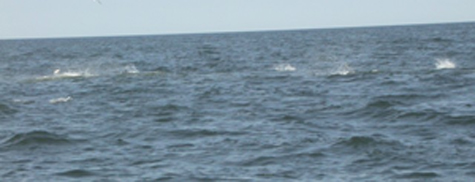
But the bass are feeding mostly on bunker, so feed them what they want. The real deal. For a typical trip the Fisher Price crew nets bunker baits in the harbor or bay, reliable spots where some of the baitfish live. Many anglers snag the bunker for bait with a snagging hook in the ocean while on the actual striped bass trip. But bunker don’t always appear at a given place in the ocean, so Fisher Price plays it safe. After the bait is in the livewell, Fisher Price breaks the inlet, starts cruising the coast. The crew searches for bunker schools, looking for telltale busting waters or birds picking the surface. The fishing can be difficult for a private boater, unless the angler fishes every day or is dialed in with others who do, Derek said. He and the crew are on the ocean daily, are on the fish, know where they’re likely to be. They’re also talking with a network of captains fishing the bass. Still, finding the bass isn’t a given, even for Derek. This year, for example, the schools constantly moved. During the week that this article was written, on one morning they swam off one town, and in the afternoon they went ballistic off the next town north, and the next morning they gathered farther south. Three trips, three locations, miles apart. The ocean’s a big place. The fish could be a mile away, and may as well be on the other side of the world. The pods of bunker don’t always hold bass. Derek and crew are looking for bunker schools that appear somewhat frightened, maybe panicked, or they’re looking for rolls and splashes. All indicate fish. But not necessarily stripers. Could be blues. Slammers 10 to 15 pounds are common. But the size and look of the rolls and splashes is a giveaway to the experienced. But even if blues are spotted, Fisher Price will normally stop and drift near the school, but sink the baits down to the bottom, where the big stripers would hold, if they’re around.
Then Fisher Price anchors at structure like rocks or wrecks where the bass sometimes gather. They do gravitate to structure at times. One example is that Derek will cut open the stomachs of bagged bass and see what they ate. Sometimes they’re packed with bunker. Schooling fish. Other times they’re packed with porgies, sea bass or ling. Wreck fish. The bass fed at structure. Drifting or anchoring is mostly what determines whether Fisher Price will fish with live bunker or chunks. If drifting through schools, live bunker are mostly fished, although a chunk or two will usually be dragged along the bottom, because the scavenger stripers might pick one up. In a school, a livelined bunker is most like the food that the stripers are chasing. So it works. Livelining is also some of the most fun fishing. There’s nothing like watching stripers come up and play with a bait, attack it, run off with it. If anchoring, chunks are fished. Actually the chunks are always the heads of the bunker, the favorite part for stripers, for unknown reasons. The chunks can act like chum, drawing the bass off the structure. Bass that hold on structure can also seem more likely to pick up a stationary chunk than chase a livelined bunker. They’re in a mode. When drifting, the live baits will be fished at whatever depths the fish finder marks stripers. Chunks are fished on the bottom. Scavenger fish are picking up craps there. If the drift is slow, a fish-finder rig is used for live bait. A 4-foot length of 30- to 50-pound fluorocarbon with a 9/0 or 10/0 Gamakatsu Octopus hook is used on the Fisher Price. Chunks are fished on the same rig, both on the drift or on the anchor. If the drift is fast, a 3-way rig with a 5- or 6-foot length of 40- to 50-pound fluoro is used for either livies or chunks. Just a tougher rig to stand up to the faster drift. The weights on the rigs are hung from a dropper a foot long. That just works. Rods in the 20- to 40-pound class are used and should have a soft tip for action but strong backbone to muscle in the big ones. Derek prefers conventional reels for line control. A thumb on the spool can easily control how fast the line can be let out as the bunker swims away, for example. He also favors mono line, more forgiving than braid. Anglers will often lose fish when setting the hook at the wrong moment. That takes experience, but mono stretches and is more forgiving. Has the temperature finally risen to 90 degrees in the shade? Then striped bass fishing has heated up too. The bite doesn’t finish with spring. Not at all. |
||
 |
||
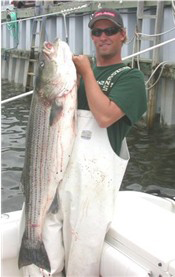
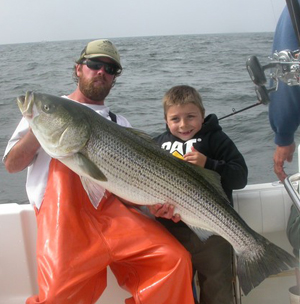 Fisher Price’s charters will mostly liveline bunker or fish chunks of the bunker to connect. Other anglers will troll lures like bunker spoons, and sometimes Fisher Price will even throw popper lures to the blitzing fish for fun.
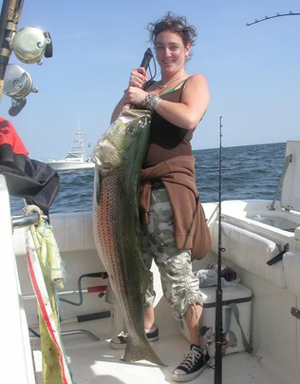 Sometimes no bunker schools are found, or sometimes none are located that hold bass.