|
|

 |
 |
 |
 |
 |
 |
 |
 |
 |
| Mon., June 8, 2026 |
 |
| Moon Phase: Last Quarter |
|
Next Full: June 29 Next New: June 14 Sunrise: 5:26 a.m. Sunset: 8:24 p.m. |
| More Info |
| Are You Ready for This? Overnight Canyon Tuna Fishing By Mark Marquez II |
||
|
Some of the best experiences build to a climax. The canyon tuna season’s no different. Small tuna are the first to move in At first the tuna are only caught More and more large tuna ride the eddies to the Edge, and by mid to late August they begin hitting both on the troll and on bait, both day and night. The canyon season is full on, The climax of all fishing. Twenty-four hours of mind-bending, tackle-busting mayhem from some of the most powerful fish, a hundred miles from shore. This isn't bluegill fishing on the If you’ve never gone, here’s what to expect on an overnight canyon charter. The weather is the biggest factor that anglers should consider, said Capt. Mike Schneider from the Katie H, a charter boat from Highlands, New Jersey. He’s found that September and October are usually the most reliable months for canyon catching off Jersey. The fishing can start peaking in August, and often does, and can last through November. So September and October are best bets, but there's a problem. Once the end of summer approaches toward late August, winds, storms Although the fishing is peaking, the weather will force many a trip to be cancelled because of rough seas. |
|
Maybe the charter is booked for Saturday to Sunday. Try to be able to take off work on Thursday to Friday or Monday to Tuesday on short notice. Not every captain can accommodate that, but Mike and crew and others do when possible. Daytime trolling trips earlier in the season can be just as fun. But the overnight trips offer more bang for the buck, Mike said. The Katie H’s overnight trips typically leave 10 a.m. and arrive at the canyons 4 hours later.
The chances of catching more fish are greater than on a daytime trolling trip. More for the money. On the first day, after trolling, the crew decides on a place to anchor and fish with bait through night. The boat is anchored, and the vessel’s spreader lights are turned on, flooding the area to attract fish, and the crew constantly tosses chunks of bait into the waters, such as cut up butterfish or sardines that draw in tuna. The anglers constantly catch bait that swims past, throwing the bait in a livewell, when no tuna are biting. Squid usually come through, and mackerel sometimes school, and both work great for bait. Live bait, dead bait or chunks—the cut up butterfish, sardines or other types of baitfish—all work, but live bait is king. Mike usually fishes six rods on the chunk. Two are set in the rod holders. Two are given to anglers to hold and feed out line. One or two are jigged. And one is rigged for swordfish that can come around. Some of the baited lines can be weighted, and some can be flat-lined or fished with no weight.
If they see the current is fast, more weight is used to sink the baits. If the current is slow, less weight or maybe no weight is used. The crew will watch the fish finder to determine where the tuna are holding to know the depths where the bait should reach. The anglers holding the rods and feeding out the line try to keep the line moving through the waters at the same speed as the current, so the hooked bait moves like the tossed chum-chunks that the fish will inhale. The anglers might let out 150 pulls, then slowly reel the line back, and start all over. Sometimes tuna gather far back in the chunk slick, and the lines that are worked like that are often the ones that will hook up in that instance. Mike always encourages one or two anglers to jig at all times. Jigging works, and chunking can involve lots of waiting, and the anglers are paying for the trip, and they might as well jig, keep active, try to catch. Butterfly jigs certainly work, but so do plain, old diamond jigs, and they’re much less expensive, and Mike tends to fish them. The swordfish rod is usually rigged with a larger reel than the tuna rods, an 80 instead of a 50, because swordfish are big and swim deep. A heavy, 200-pound leader is used for the size of the fish and the damage that its bill can inflict on the line, and a particularly big squid is usually the bait. A glow stick is attached to the leader, and the line is sent to the depths, where swordfish hang. Yellowfin tuna and longfin tuna are common catches on both the troll and the chunk at the canyons. Longfins or true albacore prefer cooler waters, so they’re usually hooked early and late in the season. Bigeye tuna can occasionally bite on the troll and will even make an appearance during chunking on occasion. Mahi mahi are commonly trolled, but they’ll also get boated on the chunk, usually when the boat first anchors, when they swim from a lobster pot buoy, where they like to gather, and check out the boat. Blue and white marlin are mostly trolled, typically in the warmest waters. In the morning the boat goes back on the troll. The main goal is always to fill the fish box. If the night went well, and the anglers are satisfied with the tuna in the box, they sometimes want to try specifically for other fish. They might want to troll for marlin, cast to the lobster pots for mahi, or even deep-drop for tilefish. One thing’s for certain, the anglers will be whooped after the long trip, but in a good way. This adventure has climaxed, and they’ll be ready to head home. But the afterglow remains. |
||

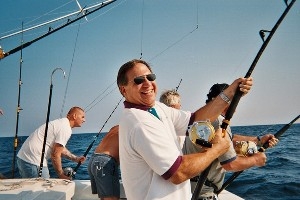 They then troll for tuna, marlin and mahi mahi during the afternoon, anchor and fish with
 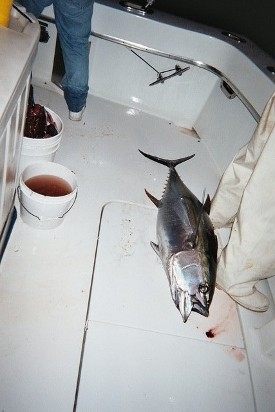 The crew watches the speed of the chunks flowing away in the waters.