Copacetic Sportfishing ,
Cape May
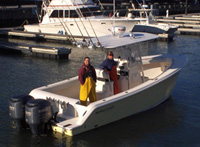
“It’s all good.”
Capt. Mike McGuigan says he partly named Copacetic Sportfishing because his grandfather used to use the word “copacetic” a lot.
But the name also came from the attitude that went along with the word.
It’s all good. That’s the outlook Capt. Mike tries to keep.
McGuigan started fishing with his dad and grandpop as soon as they felt he was old enough to safely jump aboard their boats, probably by age 5.
He grew up in Philly, but the family always vacationed at homes in Cape May, and Mike started fishing the surrounding saltwaters that he still fishes today, everywhere from Delaware Bay to the offshore canyons.
He now lives in Cape May and works in construction.
Copacetic Sportfishing starts its season with striped bass and black drum fishing in Delaware Bay. Flounder and shark trips will be added by June, and tuna fishing will begin soon afterward, lasting through fall.
In the meantime, inshore trips for blues, bonito and other speedsters will be mixed in, and bottom-fishing charters for everything from flounder to sea bass will continue.
In fall, striped bass fishing at the Cape May Rips and Delaware Bay will become a focus again during the autumn migration.
Everything will come full circle.
Copacetic!
Call:
609-770-4665 or
267-716-7648
Visit Copacetic Sportfishing's
web site.
|
|
Cape May’s anglers don’t mess around.
The tackle shops, marinas, charter boats and head boats at the port, one of the Atlantic Coast’s legendary sportfishing towns, are the state’s last to open in spring.
Yet the East Coast’s spring migration of fish, swimming north,
the annual kick-off to saltwater fishing, arrives here, the state’s southernmost point, before
anywhere else in New Jersey.
So mid April is here.
Many Jersey Coast anglers started casting a line an entire month ago.
Does that mean Cape May’s sportfishing fleet is sailing?
Well, almost.
Some of the early birds are fishing.
But everything starts to change now.
The slips at Cape May’s marinas start opening for the season,
boaters begin splashing vessels, tackle-shop doors start to be unlocked.
Why? Because striped bass are definitely biting in nearby waters, especially Delaware Bay.
There might’ve been doubt before.
But it’s a sure thing now, and Cape May’s anglers don’t mess around. There are fish to be caught, and the locals will launch their fishing seasons.
Capt. Mike McGuigan, Copacetic Sportfishing, Cape May, will be among them, one of the first to be
on the fish.
Delaware Bay is one of the first places in the state to give up striped bass in spring, because of a number of reasons.
These include the northerly migration reaching the state’s southernmost bay first.
Some of the migrating stripers
will swim up the bay to reach the Delaware River to spawn. The
river is one of largest striped
bass spawning grounds on the
coast.
|
The bay's waters are also slightly warmer because of the southern latitude. Non- migrating stripers, a certain number of immature, younger, smaller fish that live here through winter, start becoming active in spring’s rising water temperatures.
At first, these "resident" fish will be the only stripers that hold in the bay.
They start feeding when the bay reaches about 45 degrees. Migrators will soon show up and will stick around until the waters reach about 63 degrees.
The whole run, the time when residents perk up until migrators arrive and depart, lasts from about the beginning of April until mid June. The bay’s striper fishing probably peaks during a month-long period through the middle of that time, maybe late April through late May, give or take a couple of weeks.
Mike’s charters have bailed stripers in the bay as late as Memorial Day Weekend. They might’ve had to fish for them in the cooler conditions of night by then, but they loaded up.
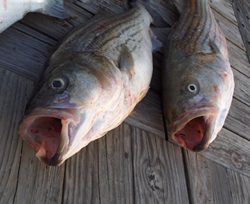 He stressed that a zillion stripers don’t all head up the bay at once. Instead, it’s a longer, slower process. He stressed that a zillion stripers don’t all head up the bay at once. Instead, it’s a longer, slower process.
In the beginning of the season, most stripers are caught in the bay’s shallow flats, the relatively warm water in 7 to 15 feet, especially from Reeds Beach to the Maurice River. These are resident fish.
Anglers sometimes toss surface lures or popping plugs to connect on the flats, while the stripers roll on top, feeding on schooling bunker and herring that swim the surface.
But anglers also fish with clams on the bottom, and clams are more popular.
Clams will become almost 100-percent popular as the season progresses, and the stripers move to deeper water. They’ll no longer chase bait on top, for the most part. They’ll hug bottom.
Now, this fishing is on the southern bay. In the northern bay, like around Money Island, bunker is the popular bait.
The reason might be that clams come from the ocean, Mike said, and the southern bay’s closer to the ocean. More bunker also seem to gather in the northern bay.
Fishing with bunker in those waters is a whole other topic.
This article’s mostly about clamming for stripers in the southern bay.
The bottom on the flats really is generally flat. So Mike doesn’t usually look for structure—drop-offs, ledges, holes and such—to fish here. Instead he looks for bait on the fish-finder. When bait is marked, he’ll stop, anchor and clam for stripers.
But soon the stripers will start sliding off the flats to the deeper sloughs and holes, waters from 20 to 60 feet. The main areas are 20-Foot Slough, 60-Foot Slough and Tussy’s Slough but also include holes and mounds in between them.
In these deeper waters, Mike looks for structure like drop-offs and edges to anchor on.
The resident fish will meet up with bigger, migrating stripers in the deeper waters.
The migrators can be trophies. Mike’s charters last year sometimes landed stripers larger than 40 pounds in the bay. Friends nabbed 50-pounders last spring.
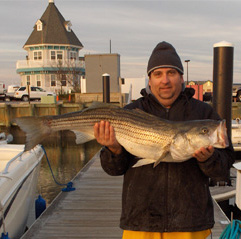 Big stripers seem more common in the bay in spring than during the fall migration, maybe because fall stripers are on the move, a trip where the only goals are to feed and reach the grounds farther south to spend the winter. Big stripers seem more common in the bay in spring than during the fall migration, maybe because fall stripers are on the move, a trip where the only goals are to feed and reach the grounds farther south to spend the winter.
Maybe in spring the big stripers are on a mission to reach the Delaware River’s spawning grounds, so they linger and move farther up the bay. But in fall, maybe big ones are on the road, just stopping by for a bite
to eat.
When clamming for the spring stripers, Mike uses a 6/0 Gamakatsu Octopus circle hook on a 25- or 30-pound fluorocarbon leader that’s 3 or 4 feet long. He’ll use a fish-finder rig.
He’ll set his charters up with 12-
to 17-pound-class, medium-heavy spinning rods, usually 7 feet long. Light rods for fun but with length and some backbone to tackle
big fish.
He’ll tell his charters to hold the rods instead of placing them in the boat’s rod holders, instructing them to keep the reels locked up. The stripers are finicky fish that bite lightly, and anglers will want to feel the hit, wait about a two count, start reeling, and if pressure is felt, pull up the rod.
Circle hooks will hook the fish best without a sharp pull-up but instead a smoother lift of the rod.
Black drum, some of them big behemoths to 70 pounds, also migrate to the same waters in spring, and also eat clams. Despite their size, they’ll hit very lightly, sometimes so lightly that anglers won’t realize that a drum is on, another reason to hold the rod.
Copacetic’s trips often catch stripers and drum on the same day. Some spots attract more drum, but a mix of stripers and drum in one area is not uncommon.
A whole surf clam is impaled on the hook, through the tongue first, because the tongue is tougher, and then the hook is threaded through the clam a few times.
The clams will be shucked either over a bucket, so the juice can be used for chum, or over the water, so the juice drops into the water for chum.
Mike and crew will toss the clam shells all around the boat, front, back and off the sides, also for chum. Two whole clams will also be cracked together and tossed in the water occasionally for chum.
No other method, like chum pots, is used for chumming. This is enough, Mike said, and clam scent is strong, travels far in the water.
At times, there might be so many fish that chumming seems unnecessary. But chumming might give an edge, and Copacetic usually always chums.
High tides from ebb to falling are usually best for Mike, for whatever reasons. He prefers trips that take place when a high tide is going to occur at some point. But high tide is no guarantee, and he certainly fishes other times.
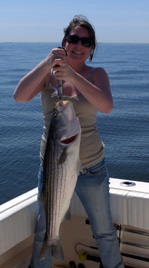 Mike will also fish the Cape May Rips, turbulent waters where the bay meets the ocean, for stripers in spring, whenever stripers appear there. Mike will also fish the Cape May Rips, turbulent waters where the bay meets the ocean, for stripers in spring, whenever stripers appear there.
The bite in the rips turns off and on, and catching the action is a matter of word of mouth. Fishing at the rips is probably steadier in fall, but in the spring, don’t count out the rips.
In the rips, Copacetic will fish mackerel strips on bucktails. This fishing is on the move, drifting, motoring to different spots, keeping an eye on the turbulence for safety.
Stripers in the rips come through in waves of the same size and age class of fish. Stripers from 24 to 28 inches might appear a moment, and 30- to 36-inchers might turn up another, for example.
Stripers in the bay tend to be a mix of sizes, although the early season fish on the flats are usually smaller fish.
Mike’s trips on the bay usually leave port at 6 or 7 a.m. and fish 8 hours. It’s a daytime bite, but in the late season will become best in lowlight hours and at night, when the water warms toward May and June.
When Copacetic is focusing on drum, trips will usually fish from dusk into night, when drum can hit best.
It’s time to get on these stripers.
Like Cape May anglers, the stripers don’t mess around either. When they come, they come big time.
Cape May's businesses might not open for fishing one moment before the action takes off.
But they'll open now.
You shouldn’t fool around either.
Get out there. It’s time. |