|
|

 |
 |
 |
 |
 |
 |
 |
 |
 |
| Mon., June 8, 2026 |
 |
| Moon Phase: Last Quarter |
|
Next Full: June 29 Next New: June 14 Sunrise: 5:26 a.m. Sunset: 8:24 p.m. |
| More Info |
| Makin' a Move Summer flounder are leaving the shallow bays for the ocean. By Mark Marquez II Posted 6/27/08 |
||
|
Seems human nature to think the grass is greener elsewhere. Many flounder anglers this season have been fishing South Jersey’s back bays so far, but now have one eye on the horizon. They’re looking at the ocean, thinking the time is coming to make a move. For them, the bays are the place to be in spring and early summer. The waters, skinny stretches trapped between the barrier islands and the mainland, are the shallowest, warmest brine in the state. If you were a fluke, you’d choose the warmer bays over the colder ocean as your swimming hole in spring, too. But the bays are about to become a little uncomfortable for the flatties. Water temperatures keep rising in summer, and the flatfish are about to break into a sweat. Well, if they could sweat. The cooler ocean will seem “greener grass.” But the ocean won’t just seem better. It will be better. By the time the bays hit 75 degrees, most flounder will escape them, said Capt. Dave Beccaria from Fine Line Fishing Charters from Margate. Some will shack up in the cooler inlets, but more will hit the chilled ocean for the rest of summer. Some flounder anglers will keep fishing the inlets in summer, but the ones who are able to sail the ocean will relocate there, except when seas become rough, and then inlets will offer shelter. Fine Line’s flounder charters will move to the ocean from the bays for the rest of summer, fishing the inlets only during kicked up seas. The ocean will hold the most flounder, and the biggest, generally bigger than the ones that swam the bays, for whatever reasons. Ocean flounder fishing will turn on best when waters reach 65 degrees or so, Dave said. |
|
Waters along the Margate beachfront were 58 degrees this week, although they fluctuated up and down a few degrees with the direction of the winds. The reefs certainly produce, but heading there isn’t crucial, because plenty of areas attract the flatbacks closer to land. Dave often fishes depths generally 35 to 50 feet. A ledge 3 ½ miles off Ocean City that drops from 45 feet to 65 feet is one favorite spot, for example. He also sails to other favorite, similar spots off Margate. But he usually never flounder fishes closer to shore than 2 miles, because junk fish or skates and sharks are prevalent there.
But on some days when none of the fluke feel like biting at those areas, he’ll move off to the Ocean City Reef or Great Egg Reef about 8 miles from the inlet. The Stone Beds are another favorite flounder grounds. When he fishes the reefs, he’ll fish the bottom surrounding the debris that makes up the artificial reefs, drifting through the area. The flatties hug the bottom near the structure. When he fishes a ledge or a hole, he’ll set up a drift to pass over the drop-off. If fish are hooked, he’ll repeat the same drift, following the line on the GPS. If nothing bites, he’ll fan out drifts along other parts of the drop-off. Just about every captain seems to prefer simple rigs without bells and whistles, and Dave’s no different. He prefers a fish-finder rig with a single, 3/0 hook on a 2-foot leader. The hook is larger than some prefer, because it helps keep smaller fish from being hooked. Dave does prefer a single green bead above the hook. It’s just a preference and works for him. He actually uses a single red bead while flounder fishing in the shallower bay, and the colors make a difference for him, but he can’t know why. One theory is that red disappears in deeper, ocean waters. So maybe the fish can see the red in the shallower bays but not in the ocean. Some knowledgeable reader might know that’s incorrect. But all that matters is that it works for Dave. Sometimes he’ll skirt the hook with a small, 3-inch, rubber squid. The color? You guessed it: green. Dave might also dress the hook with one of the small, finned, cork spinners available at tackle shops. All this tackle works for him, so he sticks with it. A combo of minnow and squid on the hook are his favorite bait. If his anglers catch sea robins, he’ll cut them in strips and use them instead of squid. Both the white part of the fish and the colored part work, and flounder seem to favor the sea robin. Likewise, if bluefish are caught, he’ll strip them out for bait.
Sometimes Dave will also use a tandem-hooked Boa rig, a rig where the length between the two hooks can be adjusted, and impale a strip of squid on the hooks. Interestingly, Dave buys his squid at the grocery store and not at the tackle shop. Meant for human consumption, squid at the grocery store are Although most anglers cut the squid in long, triangular strips, Dave cuts them in a rectangular shape. He sees no reason for a triangle, and says no tail on a fish is pointed like a triangle. He cuts the squid in long rectangles a half-inch wide. When flounder fishing in the bay, Dave encourages his anglers to work the rod, lifting it up and down 2 feet to catch more fish. But in the ocean, he tells his anglers to dead-stick the rod, because the ocean swells do the lifting. Dave prefers conventional reels for line control. When a flounder hits, he never sets the hook right away. He lets out line a moment, convenient to do with a conventional reel, lets the fish take the bait, flips the reel’s lever drag, and sets the hook. The fluke play and nibble at the bait tentatively before committing. A medium-action, 7-foot rod works well. Braid line is Dave’s preference. He uses 20-pound test, the thickness of 8-pound mono. Braid cuts through the water and is more sensitive with no stretch. He also likes Power Pro braid more than any other, and he’s tried them all. It’s less coarse, smoother and seems to last longer. Flounder fishing is the staple of all saltwater anglers in the Garden State. Part of the reason is probably because the fish is the favorite to eat. But another is probably because the flatties hug the coast a longer time than any of the other migratory fish. Flounder arrive in coastal waters in April from offshore and remain through October, when they head back to the Continental Shelf to spend the winter. Although they arrive along the coast, they don’t park themselves at one specific place all that time. The rising water temps in summer will make the flounder know it’s time to make a move from the shallow bays toward the ocean. That should tell anglers to make a move, too. |
||
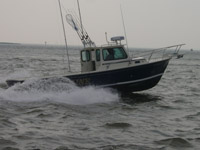
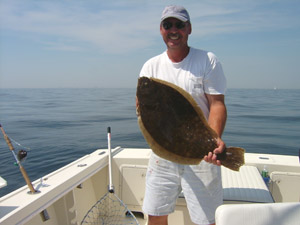 Dave simply looks for traditional fish-holding structure like sudden drop-offs and holes. If the bottom’s flat, “forget it,” he said. He’s found certain areas that produced in passed years and returns year after year, and the fish tend to hold there.
 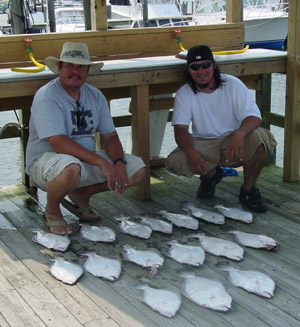 Strips of flounder also work, but with the value of a keeper flounder during this year’s harsh size limit, anglers aren’t likely to use a keeper for bait instead of dinner.