|
|

 |
 |
 |
 |
 |
 |
 |
 |
 |
| Mon., June 8, 2026 |
 |
| Moon Phase: Last Quarter |
|
Next Full: June 29 Next New: June 14 Sunrise: 5:26 a.m. Sunset: 8:24 p.m. |
| More Info |
| The Other Migration Angler’s Trek to New York’s Salmon River |
||
|
Forget about fall migrations of fish. What about fall migrations The trek of New Jersey’s anglers to upstate New York for salmon and steelhead fishing is one of the region’s most popular trips. The anglers travel to the tributaries of Lake Ontario, especially the Salmon River, year after year from fall through winter. The reason? Big, brawny fish in powerful Some anglers get so interested that they pack up the ranch and relocate their home to the banks of rivers like the Salmon. Bill Ferman, owner of High Hook Guide Service in Pulaski, N.Y., He relocated from his native New Jersey to the village 20 years ago for only one reason. Salmon, steelhead and trout fishing in the rivers of the big lake. |
|
His fishing, both with flies and conventional tackle, gets under way in the area as early as late August. But the peak begins in October, with salmon that migrate up the rivers from the lake to spawn through early November.
Brown and rainbow trout, huge, adult ones in psychedelic colors because they’re spawning, are mixed in with the salmon and steelhead at various times. But first, the salmon. King salmon, averaging 20 pounds but sometimes topping 30, are usually the first to shoot up the rivers to spawn. Kings linger in the rivers, sometimes gradually moving from pool to pool, other times remaining at the same pool for a series of days, until they spawn. Coho salmon, averaging 12 pounds but occasionally weighing 15 pounds or larger, usually come upstream after kings have started migrating. Cohos typically shoot up the rivers quickly and do their business. Different bodies of cohos migrate at different times, but quickly. Anglers mostly get shots at the fish on days when the cohos decide to speed through. The main migration of salmon usually occurs in October, a short period of time. Bill believes that a biological clock is the main factor that determines exactly when all the fish move up. Water temperatures and levels might play a part, but when the fish decide to move, they’ll head up no matter the conditions, like even if the river’s shallow. The bigger kings offer obvious angling advantages. Try managing a 30-pounder in a rip-roaring river. But many anglers believe that cohos are stronger fighters pound for pound, Bill said. Most also prefer the taste of cohos, a pinker flesh. Both fish have their angling advantages, but are caught about the same ways.
The fishing inevitably results in lots of
snags along the rocky But sacks of natural salmon, steelhead or trout eggs can be used, and sometimes Bill’s clients even fish nightcrawlers. The details of the fishing techniques vary from place to place along the rivers. Bill will target certain pools where he knows the fish will hold, or maybe he’ll look along the edges of the rivers, or maybe along certain rocks. All of the above, in other words. But the more places that are fished, the more chances of a hook-up. You don’t want to plant your legs at a run all day with no results. If the fish are there, stay, and figure out how to catch them. The depths that are fished vary from pool to pool. But generally the eggs are fished along the bottom, sunk with split shots. Fly rodders can cast a zillion types of flies. Egg patterns, Comets and naturals like stone flies and leeches are common. The fishing technique is about the same as with conventional rods.
The migrations of steelheads, fish averaging 12 pounds but sometimes weighing 20 pounds or larger, can begin in mid October and last all winter through May. Steelheads, transplanted from the American West, ancestrally had to travel up rivers 1,000 miles long at times to spawn. Although none of New York’s rivers is nearly that long, steelheads are biologically programmed to linger in the waters all winter long and spawn in the spring. However, there is a population of steelheads that makes a quick spawning run up the rivers in spring. Steelheads notoriously feed on salmon eggs. That’s a reason they enter the rivers after the salmon migration begins. So Bill’s spin anglers usually fish for them with sacks of real salmon eggs. But sometimes they also fish nightcrawlers. Of course, his fly anglers also target steelheads, and the types of flies varies as much as for salmon. The fishing techniques are basically the same as for salmon. Steelheads are harder fighters pound for pound than any of the other fish, and that’s a main attraction of angling for them. Brown and rainbow trout can simply be a by-catch for salmon and steelhead anglers.
Browns average 8 or 10 pounds, and the local record is 30 or 31 pounds. Holy smokes! They mostly migrate upstream at the end of October through November and sometimes into December. Rainbows are equally impressive in size and come upstream with the steelheads, and are the freshwater version of the sea-run steelies. Fishing for browns and rainbows uses the same methods as for salmon and steelheads. None of the fishing is particularly easy, and it takes experience. But that makes it rewarding. Anglers might score one-fish days, or might land a load, if they get lucky and hit a wall-to-wall migration on a trip. The more days anglers fish, the more chances of that happening. But those chances need to be enhanced by fishing the right location in the right ways. Location, figuring out which runs are holding the fish on a given day is the No. 1 key, Bill said. Fishing technique is No. 2. If Bill had to learn both keys all over again, one thing he’d do. He’d a hire a guide to shorten the learning curve, he said. Sounds like a good idea. But once you make the trip, be warned. You’ll want to migrate each year! |
||

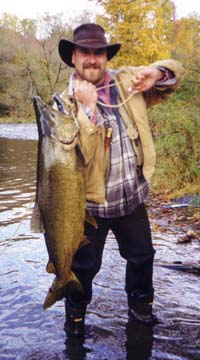 By November he’ll start concentrating on steelheads that come up the rivers, stay through winter and spawn in spring.
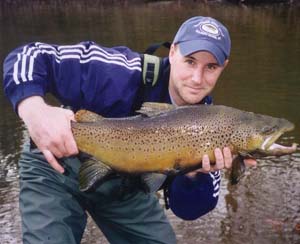 Bill’s anglers who spin fish for salmon usually cast artificial salmon egg sacks, quartering them across the current, letting them swing in an arc downstream, reeling in and doing it all over again.
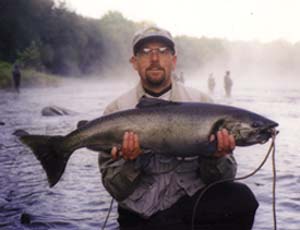 So is the technique for steelhead fishing.
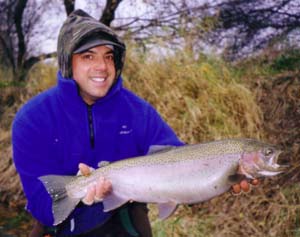 But some anglers like to hunt them specifically, because the trout are humongous—adult fish that grow in proportion to the tremendous size of the lake they come from—and are especially colorful in their spawning patterns.