|
|

 |
 |
 |
 |
 |
 |
 |
 |
 |
| Tue., June 9, 2026 |
 |
| Moon Phase: Last Quarter |
|
Next Full: June 29 Next New: June 14 Sunrise: 5:25 a.m. Sunset: 8:25 p.m. |
| More Info |
| Bicep Builders Sharking for Browns and Duskies By Mark Marquez II Originally Posted 7/25/08 |
||
|
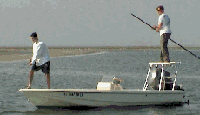
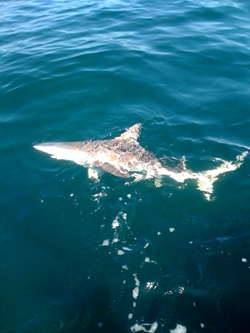
Man, the weather’s hot. You’re lazy, the fish are lazy. Nothing feels like biting. The Dog Days, an “in-between” time for fishing. The spring migration’s gone.The fall migration ’s coming. What’s an angler to do? Go sharking for browns and duskies. Not offshore, but close to shore. “It’s great,” said Capt. Joe Hughes from Jersey Cape Guide Service and Gibson’s Tackle in Sea Isle City. Mid summer can sometimes be the fishing doldrums. By July and August, coastal anglers can grow tired of catching another short flounder or 2-pound blue that are common in the warm months. But brown sharks to 25 pounds and dusky sharks to 50 pounds swim waters 5 to 15 miles from shore at These babies can dump 100 yards of line from a reel in a moment. They’re no blue sharks, Joe said. Browns and duskies will rocket off at 30 miles per hour, light-tackle fishing pushed to the limits. Few people take advantage, but Joe’s charters do, both on bait and flies. With bait his charters fish 7-foot, 12- to 20-pound-class, spinning or conventional rods, with 12- to 14-pound monofilament or 30-pound braid, either one. Joe prefers spinning rods for fun, instead of conventional. He sets course for structure such as Sea Isle Ridge, usually in 30 to 60 feet, that attracts baitfish and blues that in turn draw sharks. When the boat reaches 3 or 4 miles from the area, feathers, spoons or flies are trolled, in case fresh bluefish, the ideal bait, can be caught. |
|
When Joe and the anglers arrive on the grounds, the boat is usually drifted to cover the most waters. The fishing requires patience, because sometimes sharks will appear in the slick immediately, but others times 4 or 5 hours might pass before the fish show up.
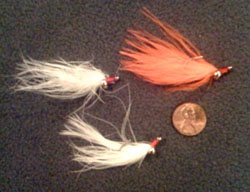
Two are flatlined with no weights, no floats, 50 to 75 yards behind the boat. The other two lines are sunk beneath the boat with 1-ounce egg sinkers, one bait placed a couple of turns down, and the other sunk halfway down the water column. Most bites come on the flatlines. When spin fishing, a baitcaster reel that can be free-spooled is perfect. When a shark slams a bait, Joe lets the fish initially run with no resistance on the line, and gradually tightens the drag. As fearsome as these fish are, they’re easily spooked. Conventional reels are also fished in free spool, with the clicker on. Fly fishing is done with small, 1/0 chum flies, usually simple patterns, often made with marabou with a Clouser type of head, that imitate a piece of chum flowing in the slick. The fly is cast into the slick and dead-drifted, with extra line coiled off the reel, so the current naturally pulls the pattern along. No movement is imparted on the fly. Again, the crazy thing is that these beasts can be incredibly afraid. In nature, nothing swims toward the sharks, and everything swims away, Joe said. If a small fly unnaturally moves toward the shark, the fish is scared to death. The anglers simply let the shark find the fly. They watch to detect when a shark inhales the fly, and the bite is usually subtle, as the shark Hoovers the fly like another piece of chum. The Clouser head of the fly works well, because it gets the fly down, with the hook pointed up, so the shark’s mouth, on the bottom of the fish, will easily wolf it in. Flies are fished close to the boat, so they can be seen. Fly rodding for the sharks is challenging, and success is not guaranteed at all. Anglers can either choose to fly fish when the opportunity presents itself while bait fishing, or can exclusively fly fish. Exclusively fly fishing ups the odds of a catch, although a catch is still no guarantee. If bait is fished while fly rodding, the bait sets up an “outer barrier,” Joe said. Sharks will attack the first food they reach in a slick. Bait will usually get hit before flies. Anglers might think summer fishing is a sluggish, lazy calm. But a little creativity can turn up surprising options. Try pitting the biceps against browns and duskies. |
||
 When bait angling, four rods are fished.