|
|

 |
 |
 |
 |
 |
 |
 |
 |
 |
| Tue., June 9, 2026 |
 |
| Moon Phase: Last Quarter |
|
Next Full: June 29 Next New: June 14 Sunrise: 5:25 a.m. Sunset: 8:25 p.m. |
| More Info |
Springtime Surprise |
||
|
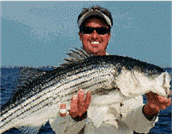
I heard a well-known fly fisher say that no new flies are ever invented. Every time he created an effective pattern that caught fish, somebody else turned out to already have created a similar version. So a similar thing might be said about so-called undiscovered fishing, especially in New Jersey, the most densely populated state. There is none. If I were to say that anglers recently discovered that lures—or also flies, because flies can work like lures—walloped South Jersey’s back-bay striped bass in spring, locals would shoot funny looks at me. Anyone knowledgeable about the fishing knows that casting the artificials is a popular way to pluck stripers from these waters in the early season. But not everybody understands just how good the action is. “It’s prime-time, great fishing,” said Capt. Joe Hughes from Jersey Cape Guide Service from Sea Isle City. The bays behind South Jersey’s barrier islands have been his home waters since boyhood. In spring he catches some of the largest numbers of stripers all year, and greater numbers on artificials than bait could score. Surprised? You probably are. Few anglers take advantage of this fishing. But for many years, it’s been Joe’s focus through most of spring. Anglers can think that the lethargic stripers in the cold, springtime bays are more likely to nose up to a stationary hunk of bait like clam or bloodworms than attack a lure. Most of the state’s saltwater anglers probably also think of fall for the best striper fishing. Epic autumn migrations of striped bass, gorging through schools of bait, is the reason. The springtime migration tends to be shorter, and the fish seem more committed to arriving at their final, summer destination than packing themselves full of food, Joe said. But the migration actually doesn’t matter much for spring back-bay fishing. The stripers in the bay in spring are residents. They’ve been holding in the waters all winter, and they’ll continue swimming there all summer. Stripers don’t seem to migrate until they’re 28 inches or larger, Joe said. Most of the bays' bass measure 20 to 28 inches. |
|
In fall, migrating, larger stripers can sometimes pop into the bays to feed a moment, but not usually in spring. The spring migration is on the move, and running in the ocean in this area. Granted, the bays' fall fishing can be bombastic, schools of stripers blitzing bait. But the spring’s fishing in the bays is more consistent, because the fish are living there, not coming and going. Steadier, more reliable. In fall, most anglers, including Joe, turn all attention to the blitzes of bass in the ocean. There’s no need for explanation. So spring is the time for sub-surface lure and fly fishing for the linesiders in the back bays. Summer also produces catches, but that’s a different story, a different type of fishing for Joe. It’s top-water popper lure fishing, because then the water is finally warm enough for bass to become active enough to pounce on top-waters. The catches in spring are great, Joe said. He’ll often land several times the stripers in the time that bait could only catch one or two.
Bait can attract bigger stripers, for whatever reasons. “But I can catch big fish if I want,” Joe said. Size is not what this fishing is about. It’s about the actual fishing, the puzzle that’s solved to catch the stripers, the skill, the fight, the possibility of landing plenty to learn lots, the estuary, the beauty of it all. Where the fish are found in spring and why is one thing to understand. In spring Joe usually targets outflows or creek mouths that drain the various shallow bays during outgoing tides. The shallows, depths 3 or 4 feet or less, are the warmest waters, like how shallow water in a pan will boil quicker than deep water, Joe said. The bottom of all of the bays is black, marshy mud, except sandy bottom near the inlets. The black mud sucks in the sunlight, helping warm the waters on the flats. Outgoing tides that pull water out from these flats are considerably warmer—sometimes 5 to 7 degrees warmer—than incoming tides that push in the cold ocean in spring. The outflows or creeks from the flats funnel bait and forage, and the stripers sit there and swallow it down. Joe in spring fishes as far away as possible from the inlets and the cold ocean, far back in the bays. Afternoons are often best, when the water has warmed the most, and clear, relatively mild days are preferred. Again, the best conditions for warmer water.
The tackle is simple. Joe’s spin-fishing anglers throw small, 6-1/2-foot rods with light, 10-pound monofilament, both for long casting of light lures, if necessary, and for the most fun with the smaller bass. The lures are often Bass Assassins or other paddle-tailed soft plastics on jigheads. Fin-S Fish or other stick baits without paddle tails work, but they take experience to impart the proper action. Paddle tails create enticing action by simply reeling them in. That’s especially handy for charters who are less experienced. The soft plastics are impaled on the lightest jigheads possible, usually 3/8 ounces, but sometimes 1/4 or 1/8 ounce. The jig should sink but not drag the bottom, and the waters are shallow. Striped bass usually bite a lure at the same level or above the fish, rarely below it, Joe said. The fish’s eyes are toward the top of the head. They’re not usually looking down. But he might play it safe by throwing in a 6- or 12-inch spider hitch to absorb shock if a big fish hits, and a 20- or 30-pound fluorocarbon leader for insurance. Sometimes the stripers are leader shy. To connect the leader to the line, he uses a no-name or Bristol knot. He favors loop knots a lot. He also uses a loop knot to connect either a lure or a fly to a leader for the best action. He uses an unusual combination of a Homer Rhodes knot with three twists of a uni-knot, but various loop knots work.
A floating or intermediate line is best, and Clouser flies are a favorite choice. Joe mostly uses a 10-pound tippet on a tapered leader with a 30- or 40-pound butt. He ties his own, but a store-bought one works fine. The method of fishing both the lures and the flies is about the same. The lures or flies are cast quartered across a creek mouth or outflow, a 45-degree angle, so the offering swings through the current. Joe will often use a stop and go, jigging type of retrieve with the lures. Jig and pause, jig and pause. With a fly he’ll often strip and pause repeatedly. In the cold water of spring the retrieve is usually slow. But that’s not a rule, and neither are any retrieves, and Joe will keep experimenting until he hits on a retrieve the fish prefer on a given day. In fact, all these rules will be broken. Joe’s first major catch of striped bass this spring attacked a Bass Assassin on a slow, steady retrieve on incoming tide, breaking usual laws. On a jig-and-pause or stop-and-go retrieve, the fish usually strike on the pause. The stripers mostly sit in one spot in the current at the creek mouths or outflows, lazily waiting for forage to come to them. Even though casting a lure or fly would seem to go against the idea that the cold, lethargic fish are reluctant to chase an artificial, they’re not actually chasing it. The artificial is attacked when it passes in front of the striper’s nose. It’s like the fish does a mathematical equation every time food passes nearby, Joe said. The stripers seem to instinctively determine whether the value of the food is greater than the energy spent trying to bite it. They’re conserving energy. Springtime stripers will keep biting through April until bluefish invade the bay in early May, but they’ll turn on again soon afterward, when the blues leave. Water 46 to 47 degrees will warm stripers enough to start feeding aggressively. Joe catches the fish straight through the summer, but tactics change in warm waters. Still, he’s landed feisty stripers in 85-degree waters in the bay. Fish that bite through a 40-degree temperature range are pretty incredible. When the blues storm into the bays in early May, striper fishing pauses a moment. The more aggressive bluefish, usually 3- to 5-pounders, but sometimes 7- or 8-pounders, take over. It’s almost like the stripers give up, letting the migrating blues rule, until they leave several weeks later. In May large, spawning, so-called “tiderunner” weakfish, trout to 13 pounds, also push into the bays, if they enter the bays on a season. They don’t always appear in abundance, and they have been scarce in the past couple of years. Fluke fishing also turns on in the bays by this time. May is the best time for the fluke fishing, and also the best to score a grand slam—a striper, bluefish, weakfish and fluke, all the major inshore species—in one outing. The fluke are also attracted to the warm, shallow water, and the back bays offer up the flatties to anglers earlier than anyplace in the state. But by Memorial Day or the beginning of June, migrating bluefish mostly leave South Jersey’s bays for the ocean, and striper fishing kicks back in. But at this point popper and top-water fishing for them begins in the back, because the water’s warmer, and Joe’s attention turns to that fishing while it’s available, though it lasts through part of fall. So the window for the best sub-surface lure and fly fishing lasts about through April in the bays. Now, all of this might sound easier than it actually is. South Jersey’s bays receive no lack of fishing pressure. With pressure comes wary, picky fish, greater difficulty in fishing. A bite might often last 20 minutes on a certain stage of a tide at a specific hole. Someone like Joe explores the waters week in and week out, comes to know how to find feeding stripers that can almost seem like they don’t exist. But they do exist. You’ve got to do your homework, or jump aboard with someone like Joe who’s done it for you. Well, it’s really no surprise that anglers in the know are wild about this fishing. But if it’s news to you, there’s good reason to get yourself on the back bays soon. Good things sometimes come in small packages, or fairly brief periods of time. The fishing is on. Better get going. |
||
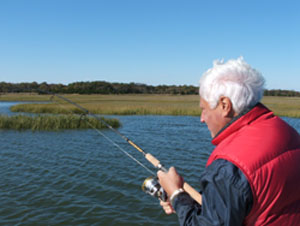 Bait fishing is about staying in one place for a long time until the bait attracts a strike. Fishing with artificials is about casting, covering lots more water, constantly searching for a hit.
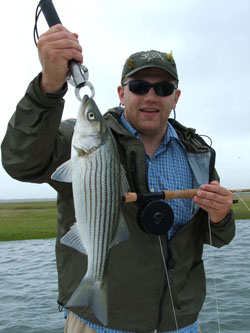 That goes against the grain of traditional wisdom that says light-sensitive stripers prefer overcast, weathery conditions, but not in the cold of spring. Just the opposite then.
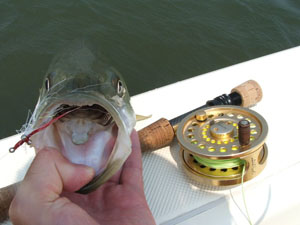 When fly fishing Joe usually casts 7- or 8-weight rods, but doesn’t hesitate to use a 10 weight in winds. “And it’s always windy,” he said.