|
|
 |
 |
 |
 |
 |
 |
 |
 |
 |
| Mon., June 8, 2026 |
 |
| Moon Phase: Last Quarter |
|
Next Full: June 29 Next New: June 14 Sunrise: 5:26 a.m. Sunset: 8:24 p.m. |
| More Info |
| Looks Aren't Everything By Mark Marquez II With this fishing, love is in the eye of the beholder. Originally posted 11/9/07 |
||
|
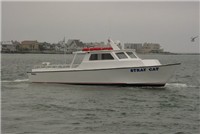
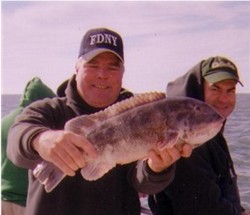
A certain type of angler is about to come into his own. Or her own. Pardon me. She somewhat gains a reputation That’s partly because of the fish the angler's about to stalk. And I do mean stalk, almost like a jilted boyfriend. Not actually crazy. That’s part of the oddball reputation. But the fish itself is like an Yep, it’s an attractive fish, And the goo. The thing is nicknamed Yeah, I’m going to catch some slipperies for dinner. Sounds like those rubbers that businessmen slip over shoes on Yet tog anglers water at the mouth to hang over the rail in wintry seas, when the fishing hits its stride, and water temperatures draw-in the big ones. So what makes the tog angler almost possessed about this? “It’s finesse fishing,” said Capt. Mike O’Neill from Stray Cat Charters from Longport, a few towns south of Atlantic City. “It’s the most finesse fishing there is,” he said. “It’s the greatest sport ever invented.” Blackfish are also tasty, whether But the sport is really the attraction. “It takes years of practice to learn to catch the big ones,” Mike said. Tog are finicky, selective feeders. They’ll tap at a bait without
|
|
Or they'll favor one bait over another on a given day; might refuse to bite So the difference between catching the fish or not involves many factors:
The swing matters, but different anglers have different swings, whatever works for the individual. Tog are known for pecking--tap, tap, tapping--at a bait, without getting hooked. Finicky eaters. Most anglers swing between taps, anticipating the next one. Some swing “like it’s World War Three,” Mike said. And some don’t. Whatever works for the angler, and this is where practice comes in. Baits The bait is match the hatch. But there are a few guidelines. Green crabs are the mainstay, because they’re the most available. But they’re scarce in spring. Calicoes are abundant in spring, and they probably work best in September and October, for whatever reasons. But calicoes won’t live long. White leggers or Jonah crabs can work well and are common in October and November. Clams usually work on small fish. The sloppy, gutsy part of the clam is fished, and fishing with the tongue will gain no bites. The baits are mostly a preference. But say the anglers on the Stray Cat are fishing calicoes, and not much is biting. Then one patron slides on a clam and begins to pile fish in the cooler. Clams are the thing that day. Rigs Mike prefers a simple leader attached to the main line with a swivel or a knot like a blood knot or an Albright. A dropper loop is tied on the main line above the leader to hold the weight. The rig fishes bait right on bottom. That is where the big tog will bite. One hook or two tandem hooks will work. Use a Virginia blackfish hook in sizes 4 to 7. Sizes 5 and 6 are most popular, but smaller or larger hooks are used, depending on the size of the bait. Black hooks are best, and there’s no need to use red hooks, because they produce fewer fish in this instance. Many anglers use Gamakatsu hooks, but Mike prefers somewhat duller hooks. The especially sharp Gamakatsus are too prone to accidents like hooked thumbs, and they can rip through the fish’s mouth quickly, losing a tog. A heavy bank sinker is tied on to the rig. The No. 1 secret to tog fishing is to get the bait as low to the bottom as possible, Mike said. To catch big tog 6 pounds or larger, the bait shouldn’t flip around, and there should be no vibration in the line, he said.
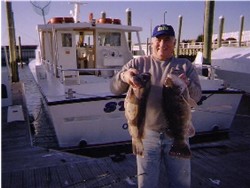
A 30-pound outfit or larger is necessary. A lighter rod and reel combo will fail to lift a big tog out of the wreck before the fish seeks cover, breaking the line. Mike’s customers use different rod lengths. Some use 5 or 6 feet, some 7, others 7 ½. Conventional reels are best, because they’re easier to pay out line and retrieve it, or can adjust the amount of line in the waters more easily. Levelwind reels are unpopular, because undoing a tangle becomes more difficult when the levelwind apparatus is in the way. Fish are lost when using a spinning reel, because of the delay in tripping the bail, reeling up slack line and setting the hook. Many anglers prefer braided line with less stretch to feel the bites and hook the fish more directly, and its thinner diameter to cut through the water for more sensitivity. But Mike prefers monofilament because of stretch, a little give when pulling in a large fish, fewer chances of ripping the hook through a tog’s mouth, losing it. When and Where Stray Cat’s tog trips mostly fish from fall to winter. They currently start November 15, because the bag limit currently jumps to eight fish per angler on that day from a limit of one earlier in the year. The limit currently will drop to four fish on January 1 through May 31, Stray Cat will keep targeting tog until winter weather becomes too harsh for anglers to fish. Mike said the deciding factor is when roads become too ice-covered for anglers to drive safely to the boat in the mornings. Last winter Stray Cat ran its final tog trip January 28. The boat will also run tog trips for a moment in spring, until sea bass fishing kicks in. Mike prefers to avoid tog fishing when the fish spawn in spring, and sea bass become popular and plentiful in spring anyway. In the fall, he’ll begin fishing for tog at wrecks 1 to 3 miles from shore. Then he’ll move a little farther from shore, from 3 to 5 miles from land, and then from 5 to 8 miles off. He’ll fish these areas all season, and won’t push farther from land. The trips will start at depths of 40 feet, and never fish beyond 90 feet, in fall. Wrecks, and not rock piles, are the structures he fishes. Tog prefer tall structure, structure rising at least 3 or 4 feet. Smoke stacks, stanchions and pilings are some favorite areas. So are drop-offs. The fish will bite in water temperatures as high as 70 and as low as 40. Once the water drops to 40, the blackfish become reluctant to bite. Mike believes tog remain on these grounds through the cold, and they enter a state that’s something like hibernation, when waters are cold. Maybe they move inshore and offshore somewhat during the seasons, but not as much as some believe, and they seem to winter at the same grounds where they spend the fall. But toward early March until the beginning of May he’ll find the fish in somewhat deeper waters, and start fishing maybe 8 to 15 miles from shore. Mike is not one to search around the ocean for the fish, and he says this is an important strategy. He knows where they are from past experience, and moving around too much is a mistake. These finicky fish turn off and on, and anglers sometimes have to wait them out. But the fish will turn on again, and anglers should be there when they do. This fishing is spot-specific. It can be a matter of inches, Mike said. When one of his patrons starts hooking fish, the crew will pile up anglers there, practically put one angler above the successful angler’s shoulder, another angler below. Forty tog might come from one specific spot. Anglers on the stern might catch nothing, while another begins bailing the fish at another spot on the rail. Why Like an examination of any endeavor in life, a close look at any type of fishing involves six basic questions: who, what, where, when, how and why. Writing a fishing story--an article about a type of fishing--is the same. Surely the story of tog asks the question “why” more than any other aspect. These silly looking, ugly fish attract an awful lot of love. You could say it’s in the eye of the beholder. Or you could say it’s the best sport ever invented. |
||
 The Swing
 Rods and Lines