|
|
 |
 |
 |
 |
 |
 |
 |
 |
 |
| Mon., June 8, 2026 |
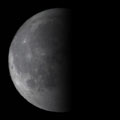 |
| Moon Phase: Last Quarter |
|
Next Full: June 29 Next New: June 14 Sunrise: 5:26 a.m. Sunset: 8:24 p.m. |
| More Info |
| Blackfishing: How I See It By Capt. Joe Skonieczny, Outcast Fishing Charters, Tottenville, Staten Island |
||
|
As an avid, longtime bottom-fisherman, I’ve come across no tougher adversary than tautog or blackfish. Over the past 30 years I’ve fished with some of the best blackfishermen on the East Coast, namely Geoff and Gregg from the Ocean Eagle from Sheepshead Bay, who wanted to remain anonymous, John Vescera, who mates on the Outcast, and outdoor writer E.C. Newellman. For anyone who’s unfamiliar, blackfish are a wreck and hard-bottom dweller that average 3 to 12 pounds. First, let’s take a look at the bait needed for a successful blackfish trip. Aboard the Outcast, we like to carry a variety of baits, including green crabs, stone crabs (a.k.a. white crabs), calico crabs and clams. Every species of crab has its place, depending on time of year and area fished. For example, if you fish in Raritan Bay, calico crabs seem to be the bait of choice. On the other hand, blackfish show a preference for stone or green crabs if you’re out in the ocean in the later months of the year. Anglers can find green crabs at the local bait shop, but calico and stone crabs are harder to come by. Clams are seldom used for blackfishing, except in the early spring, when the tog come out of their dormancy stage and have tender mouths. However, clams can be used for a by-catch of sea bass. |
|
I predominantly fish with 65-pound-test Power Pro braid with a 20- to 30-foot, 50-pound monofilament leader. My reason for using such a long leader is that monofilament is thicker in diameter and also has more buoyancy than the Power Pro, so it creates a belly in the braid. Both a good friend and the person I consider to be the best blackfishermen on the East Coast, Geoff from the Ocean Eagle, taught me another excellent trick of the trade when dealing with a touchy bite. On those days when fish seem to be backing off the bait rather than diving on it, you may want to consider the non-obvious: your sinker selection. |
||
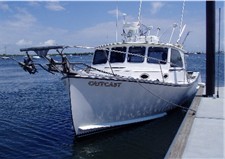 Outcast uses two anchors for blackfishing. |
The reason behind this trick again falls back to resistance. Unless the fish are really growling, they might feel the heavy lead and back off the bite. Tandem-rigged 4/0 Gamakatsu Octopus hooks are the hooks we use aboard the Outcast. We prefer these hooks for their strength and sharpness for fast penetration. Years ago, we used 5/0 Gamakatsu hooks when the fish were larger or averaged 5 pounds and up. |
|
For novice blackfisher anglers, anchoring will be the most difficult task. The Outcast typically utilizes a two-anchor system. While using one anchor is possible, it fails to give the boat critical wreck position, because of swinging or swaying in the wind and/or current. Anchoring with two anchors usually requires two people, although I’ve done it in the past by myself. One boater maneuvers the vessel while the other deploys the anchors. For example, when deploying two anchors, if the boat is going to lay due north, the starboard anchor would be deployed first at a 40- to 45-degree compass heading. The second anchor would be deployed at a 315- to 320-degree compass heading. In essence, an 80- to 90-degree spread. Anchoring is one of the more complicated aspects of blackfishing, and an in-depth article could specifically be about the techniques of anchoring. I also couldn’t possibly sum up my 30 years of experience in one article, so I hope to follow-up this article with more in-depth tips and advice. Blackfishing is one of the most challenging and most rewarding sports. I hope you can take some of this information and use it on a trip in the near future, leading you to enjoy blackfishing as much as I do. I would like to thank the many excellent anglers I have fished with and learned from over the years, including, but not limited to, John Vescera, mate aboard the Outcast; Geoff and Greg from the Ocean Eagle; Rob Skonieczny, my brother and co-owner of the Outcast; writer and angler E.C. Newellman; and my dad, John Skonieczny, who started it all. |
||
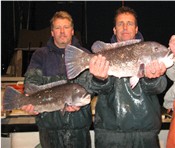
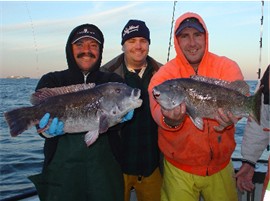 Tackle is another essential aspect.