|
|
 |
 |
 |
 |
 |
 |
 |
 |
 |
| Mon., June 8, 2026 |
 |
| Moon Phase: Last Quarter |
|
Next Full: June 29 Next New: June 14 Sunrise: 5:26 a.m. Sunset: 8:24 p.m. |
| More Info |
| Whatever It Takes By Capt. Derek Bielitz Fisher Price Charters, Highlands Clamming, eeling, jigging or trolling ... keep your options open for Sandy Hook's striped bass. Posted 11/2/07 |
||
|
Finally. The days are shorter, temperatures are dropping, and the fall striped bass migration is beginning. Anglers have been waiting for this time of year: a chance to reel in trophy stripers. Several techniques are used in the Sandy Hook area to produce stripers on a regular basis in the fall. But all have one factor in common, and that’s structure. Targeting these fish is the main focus for Fisher Price’s charters while the linesiders are here. Clamming is one of the most reliable ways to hook Sandy Hook’s stripers in the fall. Clamming is fairly simple and involves anchoring or drifting around bottom structure. The tackle is also fairly simple, a 20-pound spinning or bait-casting outfit rigged with a fish finder. We take a bushel of fresh clams and shuck them, saving the shells for chum. While on the water we use an old baseball bat to break the shells for chum every so often to lure the fish in. We also occasionally smack a whole clam with the bat and toss it in the water for chum. Half a shucked clam is globbed on the hook and cast out into the chum slick with just enough weight to hold bottom. Keep no slack in the line, and hold the rod. It’s now a waiting game. |
|
As soon as you feel something bump the line, set the hook. The bass will just inhale the clam. And the fight is on. Eeling is the second most common practice we use.
The tackle for eeling is a little heavier. Thirty-pound outfits are used, because up to 16 ounces of weight or more is sometimes used to hold bottom in the deeper or rougher water and stronger currents. The heavier outfits are also best for the larger stripers that tend to attack eels. The rig uses a three-way swivel. One leg of the swivel is tied to the main line. On another leg attach a dropper loop of about 12 to 16 inches and use the loop to attach just enough weight to hold bottom. On the third leg of the swivel attach a 3- to 4-foot leader of 30-pound fluorocarbon tied to a 4/0 Octopus hook. The eels can be hooked in several ways, but I’ve found that hooking them through both eyes keeps them alive the best and keeps them on the hook the longest. When a fish hits, let it take the eel a moment before setting the hook. The eel is a mouthful and can slip out of the striper’s mouth if the hook is set too soon.
Jigging rods are 20-pound spinning and bait-casting outfits. The jigs used can be anything from diamond jigs to rubber shads. Ava A-27 and A-47 diamond jigs are the most reliable. We lower the jigs through the water and just bounce them up and down off the bottom. Bass will usually hit them as the jig is fluttering down. As soon as you feel a strike, set the hook immediately, and keep constant pressure on the fish. There’s something about jigging that creates the natural inclination to give slack once the fish hits, an instinct to lower the rod and continue the jigging motion. But avoid that. Trolling is one of the other methods we use for fall bass catches. Although lots of people don’t like to troll—they’d prefer to hold the rod and fish with bait or jigs instead— it’s one of the most productive ways of putting fish in the boat. We generally troll shad rigs in chartreuse, pearl with black or yellow with black. I’ve found that the darker colors produce better on overcast days, and the brighter colors are best on sunnier days. We troll with wire line, because wire allows you to control the depth of the lures. For every 100 feet of wire, the rigs get down 10 feet. Bunker spoons are also trolled. Trolling bunker spoons is very effective for larger stripers when adult bunker are schooling. When trolling spoons, it’s essential to watch the tip of the rod. The rod should be pulsing, and then you know that the spoon is sweeping back and forth, looking like an injured bunker that makes a trophy bass hit. As the fall progresses, striper fishing will only heat up, because more and more fish will filter into the waters on their migration south, waiting to ambush the schools of bait that at the same time are emptying out of the local estuaries. This time of year is awesome. It’s what anglers wait for all season, in hopes of catching the trophies. It’s also the last shot at the fish before the winter doldrums set in, but goes out with a bang. Now is the time to get out there and use these methods.
But go now, the best time of year for this fishing. Hope to see you on the water. |
||
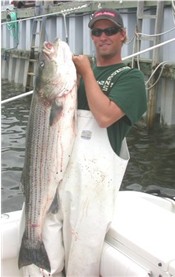
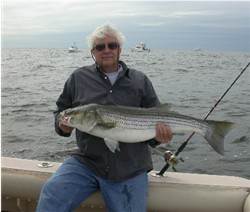 Eeling produces bass both day and night and usually accounts for some of the bigger fish taken during the fall run. We generally eel the deep waters of Sandy Hook and Ambrose Channel as well as some of the local rips, the traditional places where eeling is done, for whatever reasons.
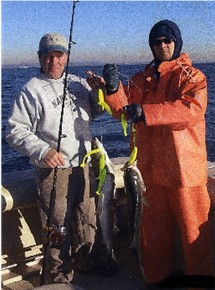 Jigging is the third way that our anglers fish for fall bass. In my personal opinion this way is probably the most fun to catch these fish.
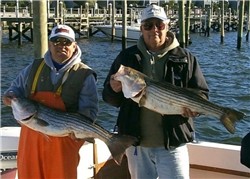 If you’d like to learn firsthand, consider booking a trip. Or take a charter to leave the work to the captain and crew, rely on their daily experience, sit back and have a great time.
