|
|

 |
 |
 |
 |
 |
 |
 |
 |
 |
| Mon., June 8, 2026 |
 |
| Moon Phase: Last Quarter |
|
Next Full: June 29 Next New: June 14 Sunrise: 5:26 a.m. Sunset: 8:24 p.m. |
| More Info |
Workingman's Blues |
|||
|
Bluefishing. New Jersey saltwater fishing's meat and potatoes, the backbone, the old standby. Bluefish are found everywhere. They’re in the bays, they’re in the surf, they’re offshore. They’re almost so common that the experienced angler is jaded. Yet thank goodness they don’t grow 10 feet long, a friend once said. Slashing, bashing, crashing, killing. A school of blues is feeding. The water turns red. Baitfish, body parts. Birds are screaming above, your mind's yelling inside. It’s pandemonium, said Capt. Bob Meimresse from the Down Deep, a Cape May charter boat. That’s why everybody loves it, he said. Bluefishing is a staple on the Down Deep, like it is for nearly any charter business on the Jersey Coast. Bluefishing off Cape May begins in mid May. The fish arrive from their winter |
||
grounds farther south. Water temps are warming, baitfish are appearing, and blues are following. But the Cape May boats really start bluefishing in mid June, and that’s because they’re targeting other species first: striped bass and black drum several weeks in spring. |
|||
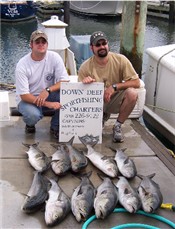 Slammers boated on the Down Deep. |
How does one find the blues? Capt. Bob simply sails to a likely lump or wreck, places that have been well-known for a long time to hold blues in summer, and he searches for clouds of bait on the bottom on his fish finder. If he can find the bait, he can usually find the blues. Trolling is the name of the game in these waters. It’s not a complicated tactic, and bluefishing never is. Remember the slashing, crashing, killing? Blues aren’t picky. They’re hungry. |
||
Clark spoons, pony tails, Stretch plugs, feathers or nearly any lures work. The Down Deep typically trolls pony tails, Stretch 25’s and a few feathers. They’re fished in a typical V-trolling pattern, nothing unusual. Troll the lures 4-1/2 to 6-1/2 knots to attract blues. One of the bonuses of this fishing is that other hard-fighting fish hold on the same grounds and can be caught while trolling in summer. Bonito, false albacore, king mackerel, Spanish mackerel and even mahi mahi make appearances. All fight just as hard, and even harder, than blues, and most are good-tasting, actually even better-tasting than bluefish. Blues were never known as one of the tastier fish. They’re palatable but are dark meat and strong. Bonito, kings, Spanish and mahi taste excellent. |
|||
To catch these non-blues, bump up the trolling speed several knots. Bob will experiment with depths, because the blues can school at different depths on a given day. |
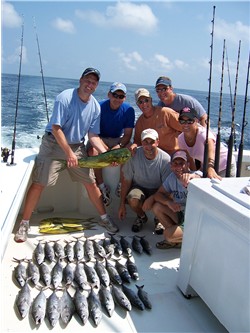 Bonito a few mahi mahi and other hard-fighting fish can sometimes be trolled at the same grounds as blues. |
||
His lures are fished anywhere from 15 feet behind the boat to 50 or 75 feet. He does try to match the hatch. For example, if the blues are feeding on sand eels, a No. 1 Clark spoon is a good imitation. He’ll also experiment with skirts on the spoons, because sometimes a different color will produce best. Just be careful not to affect the action by placing the skirt over the spoon, and instead place it mostly above. He’ll fish a spread of eight rods, and any more gets to be too crazy when a mess of blues hits many lures at once. Twenty-pound-class rods and reels with 30-pound monofilament line work well. Tie a wire leader to the lure. Remember slashing? Mono slashes. Bob uses 30-pound, thin-gauge wire, available from tackle shops, tied to the lures with a haywire twist. Sail to a likely spot, find the clouds of bait, and put out the spread. Fight the slashers until you’re conquered and content. It’s the everyman’s favorite. Workingman’s blues. |
|||