




Thu., Jan. 15, 2026
Moon Phase:
Waning Crescent
More Info
Inshore Charters
Offshore Charters
Party Boats
Saltwater
Tackle Shops &
Marinas
Saltwater
Boat Rentals
Freshwater
Guides
Freshwater
Tackle Shops
Brrr ...
It's Cold:
Upstate N.Y.
Ice Fishing
Upstate N.Y.
Winter Steelhead &
Trout Fishing
Long Island, N.Y.
Winter
Cod &
Wreck Fishing
Back Bay Clamming for Stripers
Barnegat Bay's Key to Catching Linesiders

By Capt. Capt. Jack Shea, Barnegat Bay Fishing Charters , Barnegat

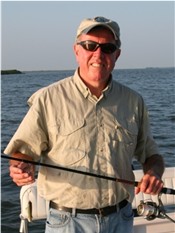
Capt. Jack Shea,
Barnegat Bay
Fishing Charters

Capt. Brian Rice

Capt. Jack Shea

Over the past 25 years, no matter how busy Capt. Jack Shea’s been, even during a demanding, non-fishing career, he’s always found the time to fish 80 to 100 days per year. This desire began when for years he used to live near Lake Hopatcong and started targeting the area’s freshwater lakes, impoundments and streams for trout, largemouth bass, smallmouth bass and other fish. By the age of 18 he was taking trips to the coast and became a surf angler, and started becoming addicted to striped bass fishing. After a career in Internet technology in the telecom industry, he moved to the shore of Barnegat Bay, and began discovering its tremendous, and maybe underappreciated, fishery for striped bass, bluefish, weakfish, flounder and fluke. He became a captain, and by 2004 he decided to run a charter business full time.

Barnegat Bay
Fishing Charters

Jack now specializes in light-tackle charter fishing in Barnegat Bay and the surrounding ocean, and in some ways the fishing’s like his freshwater-fishing past. The bay is a relatively small area, and it might not hold the biggest lunkers in the sea, but the fishing’s about the experience, the unparalleled beauty of the surroundings, and having fun, including with light tackle. Winter flounder trips are the first of Jack’s charters to run in early spring. The bay’s bluefish are the next fish to hunt, and soon big, migrating striped bass enter the bay and nearby ocean. Dunking clams for these fish is the most effective way to catch them starting in late April through June. But soon the stripers also chase bunker schools in the ocean, and Jack’s charters will snag bunker from the schools and use them as livelined or cut bait for the bass. The bay’s legendary weakfishing begins next and lasts through summer, and fluke are mixed in. Grass shrimping for weakies is the meat and potatoes of Jack’s charters until October, when the stripers and bluefish return on their migration south. Then winter sets in, leaving Jack chomping at the bit to return to back bay clamming for stripers.

Call: 609-698-3632

Visit Barnegat Bay
Fishing Charters'
web site.

Anglers looking for striped bass in the shallow waters of Barnegat Bay and other back bays turn to the humble surf clam to put fish in the boat year after year.  The technique is popular for several reasons. First, it works, because no fish in the sea doesn’t enjoy a nice clam dinner.  Second, what could be easier? Just anchor the boat, toss out a chunk of clam, and wait for the bass to inhale it. Finally, the rising cost of fuel these days makes anchoring especially appealing to most of us.

Here are a few pointers to help increase your odds of success at back bay clamming for bass.

Where and When

Back bay clamming seems to start as soon as water temps consistently push into the 50-degree range.  In my home waters of Barnegat Bay, this usually occurs toward the end of April, and the fishing remains good until the end of June or later. In the fall, the reverse process cools the water and reignites this fishery in October and November.

The relatively shallow waters combined with fairly intense boat traffic keep striped bass on the move in search of food and safety. This means we try to anchor in areas where we suspect fish are moving through, rather than trying to find a spot where fish are holding. This is in contrast to some deeper bays, where bass might be holding on pieces of structure.

Bait

The fresher the bait, the better you’ll do. Nothing beats a fresh surf clam for putting scent in the water, and scent is what will bring the traveling bass to your boat. Frozen clam will work, but needs to be changed much more frequently to keep the scent trail flowing. We’ll also employ chum logs and chopped up pieces of clam to keep a scent trail in the water. Remember, these fish are on the move so it’s up to you to cause them to find you, not the other way around.

Tackle & Rigging

My preference is always to use the lightest tackle that conditions allow. Since we’re usually anchored in the fast moving waters of the channels behind Barnegat Inlet, conventional reels matched to moderate- to fast-action rods are used to provide the power and control needed to turn a big bass when it gets itself sideways in the current. My outfits of choice for this fishing are Lamiglas Tri-Flex BL7020C’s coupled with Abu Ambassadeur 6500TC reels loaded with 15-pound mono.

Our rigs are fairly simple. In-line circle hooks in sizes 6/0 or 7/0 are snelled to 35 to 40 inches of 40-pound fluorocarbon leader. The leader is tied to one leg of a three-way swivel, and an 8-inch dropper for a bank sinker is tied to the second leg. The sinker needs to be just heavy enough to hold bottom in the current, and we’ll typically start with 4 ounces and work up to 6 to 8 ounces once the current really starts flowing. The running line is connected to the third leg.

Fishing the Clam

I use a whole surf clam on each rig, impaling it several times on the hook then locking it into place by running the hook through the tough meat of the vent. These rigs are lobbed back into the current behind the boat and allowed to settle to the bottom. The current will cause the lines to straighten out behind the boat, so the number of rigs that can be effectively

Feature Article Photo
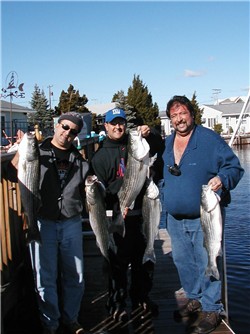
A catch of striped bass
clammed in Barnegat Bay with
Barnegat Bay Fishing Charters.

fished at one time without tangles is limited by the width of the boat. I find four rigs, two close to the boat and two down current away from the boat, work pretty effectively.

Once the rods are placed in the holders, the wait begins. Keep the scent trail going, and if there are fish around, they’ll find your baits. Since we use circle hooks, the rods remain in the holders until the fish is solidly hooked. Once a fish is on, the other lines are cleared as necessary to provide the angler with room to fight the fish without tangling.

So those are the basics. Prime time for back bay clamming is here, so let’s go fishing.