




Sun., Oct. 12, 2008
Moon Phase:
Waxing Gibbous
More Info
Inshore Charters & Guides
Offshore Charters
Party Boats
Fly Fishing Charters
Tackle Shops & Marinas
New York
Salmon, Steelhead &
Trout Fishing
Guides & Shops
More
Out of State
Charters & Guides
Fishing Tackle & Accessories
Fishing Courses
Marine Products & Services
Marine Repair & Service
Marine Insurance
Boat Rentals
Boating Safety Courses
Kayaks & Canoes
Taxidermy
Travel & Lodging
Shore Real Estate
Sales & Rentals
Baits
10 Tips to Land a Trophy Fluke

By Capt. Tommy Verderosa,
Frenzy Fishing Charters, Staten Island

Capt. Tommy Verderosa,
Frenzy Fishing Charters


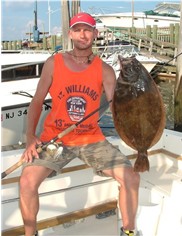
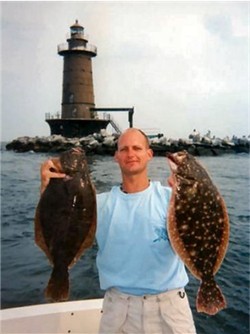
Capt. Tommy Verderosa loves fluke fishing, especially fishing for big, trophy doormats, including in tournaments. He’s won or placed in at least six fluke tournaments in the past few years, including winning second prize in the Jim Ryan Memorial Fluke Tournament on Staten Island this year, winning first prize in that event two years ago, and winning a total of three fluke tournaments that year. He placed in three last year, and now he’s likely on his way to winning more, even about to compete in the well-known Vinny Sasek Fluke Tournament the day after this article was posted.

Tommy usually enters the competitions with a team made up of himself, his friend Tom Smolka and Tom’s son Chris Smolka. Tommy wanted to make sure his team was mentioned and said his friend Tom taught him much about the fishing.

Capt. Tommy grew up on Staten Island, in the shadow of Manhattan, and is a New York City fireman. He still gets a kick out of fishing the unusually fertile waters of New York Harbor with the backdrop of the skyscrapers of the world’s greatest city. He enjoys sharing that experience with his charter customers.

Tommy’s first fishing took place as a boy who couldn’t be kept away from fishing Staten Island’s piers as the sun rose on the surrounding skyline and the bustling waters of the harbor. Slammer bluefish and sometimes weakfish, fluke or stripers were the targets. The striper population was in decline in those days.

Tommy’s customers now target fluke, striped bass, blues, weakfish and anything else that swims from the harbor to the bay to the nearby ocean, including false albacore and bonito, the speedsters from the tuna family. During spring and fall, trophy stripers are especially a focus, and Tommy’s charters often specialize in livelining big bunker for the linesiders.

Tommy’s an avid light-tackle angler, and he’s also a fly fisherman, fly tyer and a custom rod builder. He loves to either introduce anglers to saltwater fly fishing or explore the more technical details of the sport with experienced fly rodders. Tommy is a creative, thoughtful, energetic person, with the energy you’d expect from a New York City fireman, and the personality to boot. You’d have to talk with him to understand, but you would know quickly. His main goal is to help people enjoy and learn about the fishing.

Call: 917-302-4482

Visit Frenzy Fishing Charters’ web site.

Now that the season to catch big
stripers has slowed down, most of us
are switching over to fluke fishing.

I love fluke fishing, especially targeting big doormats, and sometimes I compete in fluke tournaments. I’ve learned some things that have helped me win or place in the tournaments.

During summer lots of these competitions take place that you could try your hand at. 

Here are a few tips that have helped me land a winning fluke on tournament day:

1.) Always have a few rods rigged and ready to go.  If one gets tangled, pick up another, and don't waste time.

2.)  I check my bait often, especially to make sure it's swimming correctly. You don't want to waste precious time fishing with fouled bait or no bait.

3.)  I like to use a loop knot, because it adds more fluttering action to the bait, enticing more strikes. I tie the loop to a 4/0 or 5/0 Gamakatsu hook.

4.)  Braided line is a must.  It enables you to use lighter sinkers because of the thinner diameter. It also lets you feel every strike, because there is no stretch.

5.)    The old saying is true:
Big bait = big fish. When I’m using a strip bait, the strip is at least 10 inches long and is fished with a big spearing, snapper or herring.  Whenever possible, live bait is best, especially snappers, baby bluefish 4 to 7 inches long and hooked through the lips or nostrils.

6.)  Learn to “drop back” on fluke.  With big strip baits or live bait, a strike from a big fluke will often feel like you snagged the bottom.  Here you should hesitate with the reel in free spool.  Let several feet of line slip from the reel with the rod pointed towards the fish.  Engage the reel and lift the tip slowly until you feel the weight of the fish.  Then make a short, sharp jerk upward to set the hook.  Be sure not to force the fish up. Don't try to fight the fish with the reel. Let him fight the bend of the rod--that's what the rod is for.  Most importantly, never let the fluke have slack line to play with, or he'll shake the hook out.  Reel the fluke up smoothly and steadily.  Once the fish is near the surface, do not pull him out of the water.  Keep him a few inches under the surface, and guide his head into the net.  If the fluke's back touches the surface air, he’ll shake and dive down, which could cause you to lose the fish.

7.)  One of the rigs that I use consists of a three-way swivel. On one of the swivel eyes I attach a 10-inch monofilament leader with a loop tied at the end for switching different size sinkers. On the other eye I attach a 40-inch leader with a white skirt and 4/0 Gamakatsu hook at the end.  On the same 40-inch leader, I tie a dropper loop 16 inches up from the tail hook.  On the tail hook, I use a long strip bait.  On the dropper hook, I’ve been getting mean hook ups on the new Berkley Gulp baits, including crab, sand eels and squid. 

8.)   When fishing clear water, like Ambrose Channel in my home waters, I prefer to use Fluorocarbon leaders.  On tournament day, any edge you can get will only help. 

9).  Once you hook a good fish, mark the spot immediately, either by tossing over a marker buoy, hitting the “man overboard” button on your GPS, or taking

Feature Article Photo

some land ranges.  Then drift over the spot from different angles to try to hook another good fish. 

10). I like to use a de-hooker tool.  This allows me to release the small, unwanted fish quickly, allowing more fishing time.

I hope these tips will help you land a trophy fish this season.  Good luck!