|
|

 |
 |
 |
 |
 |
 |
 |
 |
 |
| Mon., Jan. 5, 2026 |
 |
| Moon Phase: Waning Gibbous |
|
Next Full: Feb. 3 Next New: Jan. 19 Sunrise: 7:19 a.m. Sunset: 4:44 p.m. |
| More Info |
page 2 of 2 |
|
| Hot Fun in the Summertime | |
Continued from previous page ... |
|
Now we need to think about the supplies for a successful trip. Some things are essential and others are convenient. Crabbing can be extremely inexpensive, because you could go crabbing with little more than a chicken neck, a roll of line and a net. Or crabbing can be progressively more costly, depending on your preferences. Let’s start with essentials. You’ll need some sort of traps or hand lines, a net if using the latter, bait, a knife for cutting the bait, a measuring stick, and something to store crabs. A bucket or bushel basket with a lid work well. You should also add lots of drinking water, bug spray and suntan lotion. A huge variety of traps are available. Many can be found at your favorite tackle shop, sporting goods store or department store. When you’re in a small fishing town, keep an eye out for hand-made traps at the tackle shops. Some Old Salt Types make their own traps, and they’re usually very good quality, but a rare find these days.
Round-basket traps are cotton, wire or coated wire. They consist of a round hoop with the netting attached from that hoop to a smaller one, creating a basket that falls flat when it lies on the bottom of the waterway. You attach bait and a sinker to the bottom and a line from the top, and drop the trap into the water. These are great, especially if you’re crabbing from a bridge. After waiting several minutes for the crabs to find the bait, you quickly pull up the trap and snare your blueclaws. These traps are easy to use, easy to store and quite effective. The cotton ones are very inexpensive, but the wire ones last longer. Box and pyramid traps are made from wire and come in a variety of sizes and types. They might have two or four doors, and the quality might range from great to not-worth–the-trouble. You really want to look at how well they’re put together. Make sure the doors close properly and that the panels are secure, so they won’t slip open and let your crabs escape. If you have to assemble them, determine how difficult the project will be. Some of these traps can fold for storage, but others may be bulky to store, especially the pyramid traps. Keep in mind that after you crab, if you want to keep your traps in great shape, it’s wise to rinse the traps in fresh water with the hose and let them dry completely before storing them. Saltwater does terrible things to metal. You’ll need to secure bait and 5- to 8-ounce sinkers or weights to the traps. Bait clips are really handy but optional. They’re essentially big pins, like an oversized diaper pin, that secure the bait and the sinker to the trap. You can impale your bait onto it, attach the sinker, and close the pin. No fuss, no muss. You can find these at tackle shops. At some dollar stores you can also find those old-fashioned, metal, curtain rod clips that work just fine. Or you can just tie the bait and sinker on with string.
Hand lines are another story. Pre-made varieties are available, but you can easily make your own by tying line onto a short stick (which you can also mark at 4 ½ inches, the size limit for hardshells) and tying a bait clip and a 5- to 8-ounce sinker on the other end. You can skip the bait clip and just tie on the sinker and bait if you want. With a hand line, you’ll also need a scoop net. You just drop the bait into the water, wait a few minutes until you feel the crab tugging, and very slowly pull the bait toward you, but not out of the water. When the crab becomes visible, you or someone else dips the net into the water to catch the crab while it’s preoccupied with lunch. This requires a bit more skill than the box or basket traps but is lots of fun. You would think that small children wouldn’t be able to do this, but some youngsters are surprisingly good at hand lining. Another option is to wade into the shallow water with just a dip net and scoop the crabs up! This is most effective with soft shell or shedder crabs, since they’re in a weakened state and hiding near the grass. You can catch the hard shells too, if they’re plentiful. One essential item is a measuring stick or ruler. Any hardshell blueclaw taken from New Jersey waters needs to be at least 4 ½ inches long from point to point of its shell body. You’ll need some sort of way to measure the crabs. We find that a paint stick or stirrer is great for this. Just measure out 4 ½ inches and mark a line. You can also make a notch in a piece of wood or metal or find one commercially sold. You’re allowed to keep one bushel of crabs per person. You need to store your crabs once their caught. A bushel basket with a lid works well. You just need something to contain the crabs and keep them in the shade. If you use a bucket or cooler, do not put water in it. The crabs will use all the oxygen from the water then drown. Just keep them out of the sun and they’ll be fine. If it will be quite a while before you cook them, put some ice on them, but be careful not to let the melting ice puddle. Optionally, you may want to bring a pair of tongs for crab handling. You might also want to bring an old piece of wood or cutting board to cut your bait on. Whatever makes it more convenient for you. Other items might include gloves for bait handling, hand sanitizer, wash water, and a lunch or snacks. A disposable camera is a nice idea, and a cell phone may come in handy. Bait is the next essential item. The two types of bait that are most popular are bunker (menhaden) and chicken. I’m often asked which works better, but I really don’t think crabs are that fussy. Let’s face it, they’re scavengers, bottom feeders that’ll eat pretty much anything, dead or alive, including each other! Some people swear by bunker and others chicken, and some use a little of both. They’re both inexpensive and easy to find. Bunker can be found either fresh or frozen at most bait and tackle shops. These fish can be cut into two or three pieces each and used for bait.
Eel is another great crab bait. It’s on the expensive side, but if you happen to catch an eel while crabbing, you can cut it into 4-inch pieces and use it for bait. I’ve seen other things too, like bacon and pierced cat food cans tied into the leg of a pair of pantyhose. I saw one person who drizzled shedder crab oil into the water near the boat. That actually worked to catch a bunch of crabs, but we’re not sure if that was just a coincidence. One thing for certain is that it is important to change your bait every couple of hours. The water will eventually wash away all the oils that attract the crabs, so it’s a good idea to freshen it up. Once you start to catch crabs, you must know how to handle them. Probably the best thing you can do to become a great crabber is practice. Luck and persistence are the two biggest factors in crabbing. The more you go crabbing, the better you’ll become at using the traps or hand lines. You’ll find the right combination of factors that work for you, and you’ll find crabbing spots that are bountiful. It seems that most people go crabbing not just for the crabs, but for the experience of being out in nature, sharing good times with their friends and family or just to get away from life’s everyday hassles. They also might get to catch a turtle or an eel or see a bald eagle or a mud hen for the first time. They might even have a great conversation about nothing. Brothers and sisters might get along for the day. It’s just a great time waiting to happen. |
|
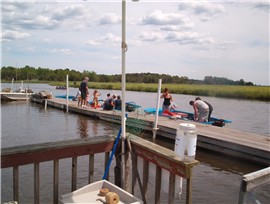 Basic types are the round-basket trap and the square or pyramid door traps.
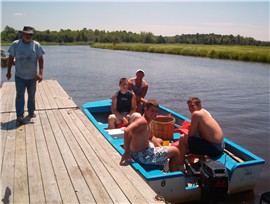 Once you’ve chosen the right trap for you, attach the bait and sinker to the bottom of the trap and either drop or throw the trap so that the doors open when it sits on the bottom. Wait several minutes for the crabs to find the bait, then quickly pull up the trap.
 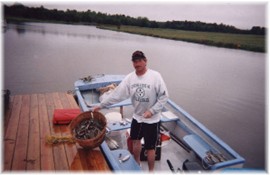 If you use chicken, the best choices are necks, backs or wings. These are the most inexpensive and work very well. You can find these at your local butcher or grocery store. Do not buy boneless, skinless chicken breasts thinking the crabs will like the more expensive stuff better. You want lots of skin, because the oils in the skin will spread in the water and draw the crabs to the trap. Don’t buy cooked chicken. They like it raw.
